How it looks
It opens on fifty-five turned backs in one solid block, with the five hidden behind them. Halfway through the intro everyone jumps round at once, the block splits down the middle, and the five walk out through the gap.
After that the shape of the song does the work. Verses are small: soloists out front, everyone else swaying. Every chorus is a wall of sixty people doing the same six gestures, one for each promise in the lyric. In the middle the block splits again into a soul train aisle for the five to show off in. Then the lights drop for a verse of phone torches, and the last three choruses build until all sixty are squeezed into one bouncing group photo.
Who stands where
- The five are numbered 1 to 5. Lead 1 owns the centre. Leads 2 and 4 always work the Team Never side, leads 3 and 5 the Team Gonna side.
- Team Never is 28 people on the left as the audience sees it, in four rows of seven.
- Team Gonna is 27 people on the right: three rows of seven and a back row of six.
- Rows are lettered A at the front to D at the back. Shortest people in A, tallest in D, and everyone stands in the gap between the two heads in front.
- Each team has a captain: the person in row A next to the middle. Captains shout the next move a bar early, so nobody has to remember the order.
You need a space about 10 metres wide and 6 deep once the aisle is open. With less room, use more rows of fewer people. The plan works as long as there are two teams with a gap that can open between them.
Two strips of tape on the floor save a lot of shouting: one down the centre line, one across the front where the five stand in a line. If you can, put Team Never in one colour of top and Team Gonna in another. The five get the trench coats and sunglasses.
The moves
Twelve in total, and the chorus teams only need eight of them. The figures move at the speed of the song and work like a mirror: when they go to your right, you go to your right. The numbers underneath are the counts.
For everyone
All sixty people do these, the five included.
For the five
Bigger versions for the people out front. Yellow heads, because they are the yellow dots on the map.
Cue sheet
Every position change in order, with the time it happens. Print the page if the captains want it on paper; the buttons and timeline drop out.
Teach it in 40 minutes
- Line up, 5 minutes. Sort into two teams and four rows. Practise "Aisle!" and "Close!" until both happen in two steps.
- The six Nevers, 10 minutes. Slowly with no music first, calling the key word for each gesture. Then with the chorus on repeat.
- The Rick step, 5 minutes. On its own, then underneath the six Nevers. Anyone who can't do both keeps the gestures and drops the feet.
- The build, 5 minutes. The only thing that matters is that the clap lands together.
- The quiet moves, 5 minutes. Snap and sway, old friends, torches. These take one go each.
- Two full runs, 10 minutes. With the stage map on a screen and the captains calling.
While the teams learn the gestures, the five go next door and sort out four things: the walk-on order, who sings which line of verse 1, the order they leave the aisle in the bridge, and the kneel.
One rule covers every mistake: if you're lost, copy the lead nearest you, keep singing and keep smiling. Nobody watches feet.
On the night
- Check the track is the original 3:32 single, not a remix or a re-recording.
- Tape marks down, phones charged for the torch verse.
- Whoever presses play stands in row D beside the speaker and has the one-second drum fill to turn their back.
- The track fades out. Pull the volume down sharply after the last line so the freeze lands in silence.
- If you're filming, put the camera high and dead centre.
Real GIFs
The man himself, from the 1987 video. This is the whole brief for the five: feet barely move, hips go side to side, arms swing loose. These three load from giphy.com, so they need an internet connection. Everything else on this page works offline.

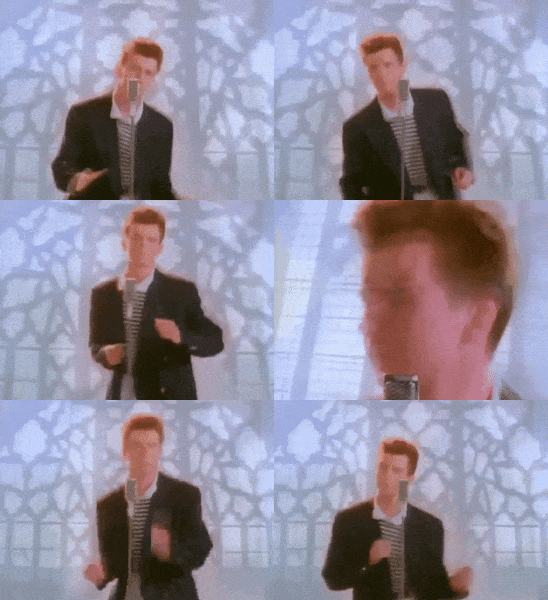

Each move above also has a link to GIFs of real people doing it. To check a section against the record, the official video opens at the right moment from these links: verse 1, chorus 1, the bridge, the final choruses.